“In most of my childhood memories, I’m alone”
Ten-year-old Filip and his father head to town to buy shoes, but circumstances force the boy to complete the mission on his own. A quirky mix-up – buying two right shoes – turns a simple task into an adventurous quest. He decides to fix the problem himself and sets off across the Romanian countryside. Over a two-day journey, filled with moments of minor fears and great courage, Filip finds an unlikely companion in a stray dog and overcomes his anxieties.
After its successful premiere at the Berlinale, many will have their first (or renewed) encounter with Romanian children’s cinema through a timeless story that deals in a rather understated way with powerful (and therefore clearly relatable for children) emotions: fear, loneliness and connection.
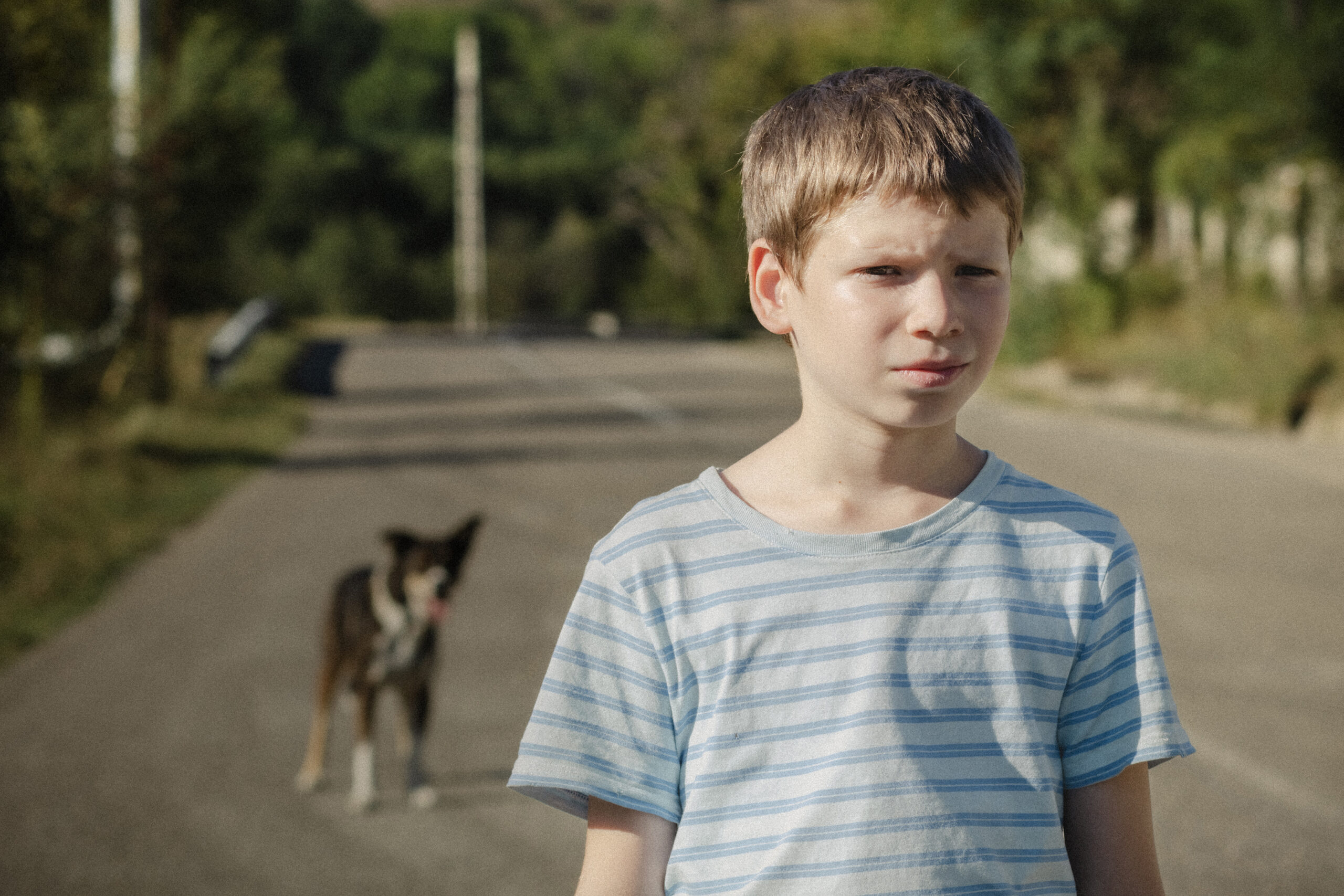
Is fear the biggest thing holding us back in life?
Paul Negoescu: At least for me. I remember when I used to go sailing as a child, I was afraid of strong winds. Every morning, I looked out the window, and even the smallest leaf trembling in the wind horrified me. In general, I have more fears now than when I was a child: the fear of change, of getting old, of death… Once you become more self-aware, you fear being judged by others. All these fears hold you back and keep you from enjoying life to the fullest.
Fear also controls your main character’s life.
Negoescu: Although Mihai Mincan wrote the story, it feels as if it’s based on my own childhood. While working on the script, I added my own experiences and all my fears.
Are you a city boy?
Negoescu: I was born in Bucharest, and I’ve lived there all my life.
But ATLAS OF THE UNIVERSE shows a strong connection with rural life. Even the rhythm matches that of country life.
Negoescu: When I was a kid, we spent our holidays in the countryside, in the deserted house where my grandfather had grown up. I insisted on shooting part of the film in the area where I spent my childhood summers. When Filip goes to town, it is the same town I used to go to. During the Ceausescu regime, they built apartment blocks and factories, which all went bankrupt after the revolution, except the cement factory, which is still in operation.
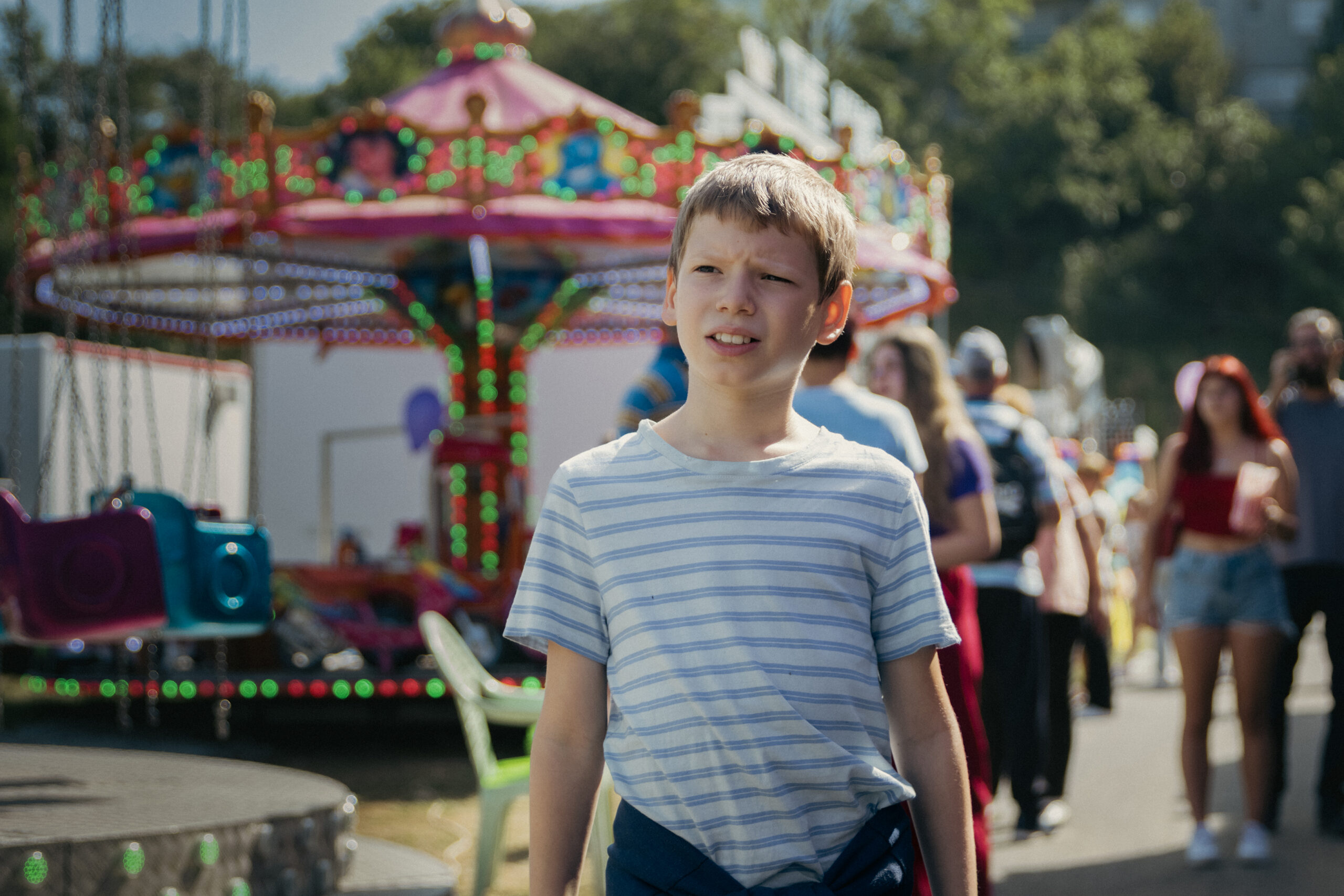
Is there really a place called Grebenișu?
Negoescu: There actually is a village called Grebenișu, but I’ve never been there. The town where we shot the film is called Fieni.
Filip’s journey there feels like an entire lifetime packed into a single day.
Negoescu: It’s the story of a boy mapping and expanding his universe. It’s like an odyssey – he travels maybe 20 or 30 kilometres. In fact, we never get to understand exactly how far it is; the scale remains unclear.
And you have the nerve to call your film ATLAS OF THE UNIVERSE! The nicest thing for me is that in his universe, there are no bad people.
Negoescu: There are many challenges, but none of them are evil. That makes it an unconventional story. Things that seem threatening at first – like a blind man with a donkey, a stray dog, or kids playing football on the street – aren’t really that scary.
Part of his odyssey is falling in love, though I’m not sure that’s the right word.
Negoescu: He connects with a stranger. It’s probably his first close encounter with a girl other than his mother. She’s from the Hungarian minority in Romania; she doesn’t speak Romanian, and Filip doesn’t speak a word of Hungarian. Little by little, a bond grows, despite the language barrier. Through this connection, Filip understands there’s no reason to keep people at a distance if you can also get to know and embrace them. In the end, we’re all just people living on the same planet.
Despite all those people, he’s often the only one in the shot. That’s what touched me most: images of a small boy, with or without a dog.
Negoescu: Beyond fears and courage, this film is also about loneliness. That’s what moved me in the script. After all, in most of my childhood memories, I’m alone. Together with DoP Ana Drăghici, we decided to frame Matei Donciu (who plays Filip) alone as much as possible. Except for a few rare moments – like with the girl on the carousel, or with the kids in Grebenișu – he’s completely on his own.

How are your memories so steeped in loneliness?
Negoescu: I spent my childhood in the ’90s, which was a rough time in Romania. In a post-socialist world, there was no social safety net, and bringing food on the table was a struggle. Most parents had to work all day and leave their kids home alone. Many products were hard to find. Even in Bucharest, you had to spend half a day searching to find shoes that fit. I remember buying a pair in the morning, and by evening they were ruined because of their poor quality. My sister and I were often left alone. When I came home from school, I often rode my little bike around the neighbourhood for hours, all by myself.
Is a child’s existential loneliness different from an adult’s?
Negoescu: We all have our own story. I’d forgotten about my lonely moments, but when I read the script, it all came back and made me feel very emotional. It still lies somewhere deep inside me. The funny thing is, I didn’t realise I was alone – I don’t know if children really understand how lonely Filip is. That’s why the best reactions so far came from adults.
Would you call this movie nostalgic, with all its references to your childhood?
Negoescu: There is indeed a certain longing, and the picture we paint of rural life is a bit fake. When we scouted locations in the countryside, I realised there were a lot more cars and people… We kept the atmosphere a bit desolate, to stay true to my memories. I remember feeling most lonely on Sundays; everyone was sleeping, Romanian TV didn’t broadcast, so there was nothing to do except ride my bicycle around the block. No one was out on the streets; you could hear the birds chirping. That is the atmosphere we’re striving for in ATLAS OF THE UNIVERSE, although our story is set on a Saturday.

Despite this timeless picture of a country where time seems to have stood still for 60 years, I’m sure Romania is more than just dusty villages and drunk fathers.
Negoescu: You’re right about the villages, but I’m less sure about the fathers. I think this is a typical Romanian father.
One that would leave his child behind without a blink, just to go to a bar? On top of that, he seems like a nice guy!
Negoescu: He is! He’s not a good parent, but he’s a nice guy. I wouldn’t exactly hold Romanian fathers up as role models.
In this society, you don’t throw away your bike just because it breaks. You don’t throw away two left shoes.
Negoescu: In my family, we don’t throw anything away until it’s completely worn out. I have some shoes that have been broken for years, but I’m still keeping them. Maybe someday I’ll find a way to fix them.
You only had 24 shooting days. Filmmakers usually count on 30 days – sometimes even considerably more – because children are only allowed on set for a limited number of hours. Don’t those regulations apply in Romania?
Negoescu: Yes, but do waiting periods between shots count too? Some days we were on set for many hours, but Matei’s actual work didn’t take that long; he had to wait for hours for the shot to be ready. He had his own camper van; his parents were there, and between shots, he either slept or played with the other kids on set. The hardest part was the night shoots. We started setting up an hour before sunset and worked until midnight. The only scene that ran longer was the one where Filip is driven home in the car while half-asleep. When we shot that scene in the middle of the night, Matei was actually half asleep.
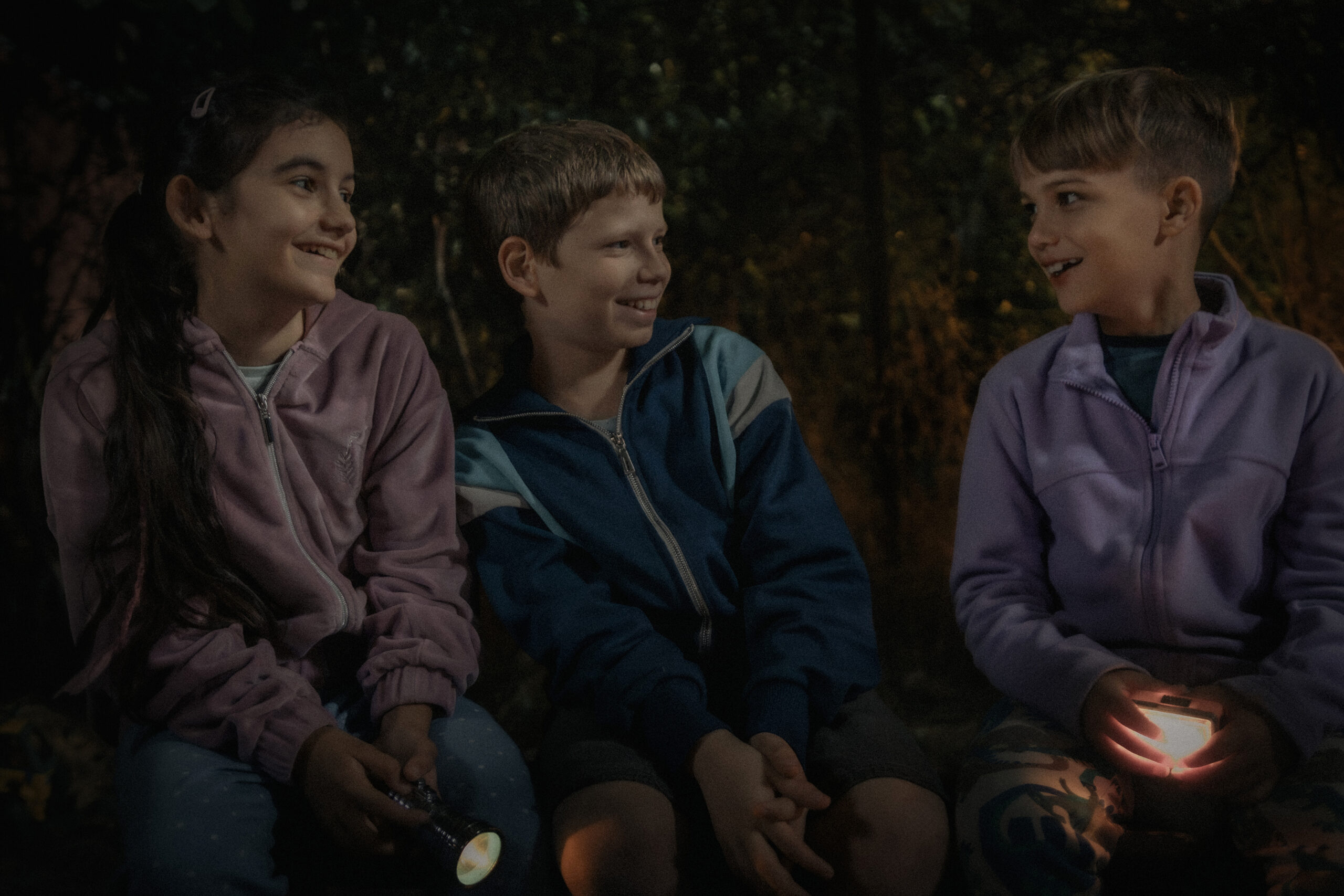
How did you manage to do the job in such a short time?
Negoescu: We were lucky with Matei! He could memorise his lines quickly; we never needed many takes, and the dog did a great job, too. The idea that children and animals slow you down didn’t apply to us. It also helped that this was already my sixth film, so I do have some experience with efficiency. We started the project with a 36-day schedule, then it was cut back to 24 days. I told my producer: “We’ll never pull this off, but we can at least try.” It felt impossible, but we managed. We were rushing around the whole time. Sometimes we had time for only two takes before rushing to the next shot. But we were well prepared; we’d rehearsed thoroughly, and our fantastic team helped me work very quickly.
What does Filip’s brother Andy stand for?
Negoescu: He is Filip’s role model. Many children dream of becoming football players; it’s their ticket out of poverty. Andy moved to Italy to play football, but he didn’t make it and now works at a meat factory. That part connects to daily reality: many young people leave Romania to work in the West, where wages are higher. Andy’s story is one of failure, but in Filip’s small world, it sounds like a success story.
It had been a long time since we’d seen a Romanian children’s movie. I only remember a few teen dramas.
Negoescu: Because all movie theaters were closed after the revolution. Between 2000 and 2008, we had 20 cinemas nationwide for a population of 20 million. Then the multiplexes came, and now every city has a movie theater. But filmmakers still wonder why they would make a film if it can’t be screened anywhere. Films were no longer made for the domestic market, although we used to have a strong tradition, supported by our national television, which produced children’s films and programmes, but that was a long time ago.
Copyright: ECFA
Published in ECFA Journal October 2026