“Wait! It’s coming!”
People and animals arranged in geometric constellations, prompting conversations that never take place and quasi-serious observations of comical situations. If we can consider Estonians to be people with a penchant for dry humour, then BAA–BAA by young director Teresa Juksaar is the ultimate and downright hilarious tribute to the Estonian national character. Young director Teresa Juksaar came to visit the Filem’On festival to explain this remarkable observation.

A family that has just moved into their new flat in the city finds a goat at their door, an unexpected gift as part of a charity drive. This is the beginning of an odyssey of man and goat, travelling together through the city. In this strictly regulated environment, every animal seems an anachronism. Only the daughter of the house thinks differently…
We wonder how dogs actually see the world; they see things differently than we do. Similarly, I wonder how you see the world because we’re looking at the same things, but what you depict in your film looks completely different from what I see.
Teresa Juksaar: My grandmother was an abstract painter; her works were highly expressive. I like to think of my films as abstract with eccentric elements. I consider myself quite a melancholic person who needs colours and humour to survive life’s challenges.
Trying to describe your film, I’d say that everything is normal, yet nothing is truly normal. Every conversation feels a bit awkward, with people standing in geometric constellations or just staring at each other.
Juksaar: I’m inspired by what I experience in life, so in some way, I’m depicting reality. This is how I experience my world. I love people and the weird and silly things they do in their everyday lives. There’s a lot of cruelty in this world, but I focus on the good and prefer to approach serious topics with a healthy sense of humour.

Even the dogs and cats in your film are behaving weirdly. And there were a lot of them! You had cats, goats, Rottweilers and bloodhounds on set.
Juksaar: I’d say that having animals interact with each other in an urban environment is rather strange, even though they’re just behaving as they normally would. The two Rottweilers were the hardest part of the animal directing. They wanted to go after the goat. We had to use a sort of cloth so the dogs couldn’t see the goats; otherwise, they would have lost control. We used green screen in that shot; it wasn’t possible to have all of them together in the same frame.
Which leads us to the true hero of the movie… The goat!
Juksaar: We cast two male goats, one year before the shoot. But when we returned to the farm one week before the start, they had simply grown too big. So the goats had to be recast. That’s when we found two female goats, Kuusi and Kola. We needed two because goats are herd animals, and we used whoever was more cooperative at that moment. They both looked very different, although nobody but me seemed to notice.
Were your goats disciplined?
Juksaar: With so many challenging elements, like the weather, children, a lot of extras, and several demanding locations, the goats for sure weren’t the hardest part. They behaved quite well; they pooped a lot though.

On command?
Juksaar: No, that scene happened spontaneously; it wasn’t in the script. When I said ‘cut’, the DoP shouted: “Wait! It’s coming!” Then I saw what he meant.
The film shows a healthy interest in animal poo, regardless of all the ‘no shitting’ signboards, wherever you look.
Juksaar: I created an atmosphere of a place where nothing is allowed; signboards are everywhere. In a city deprived of green spaces, the goat is bringing a sense of ‘nature’, until you bump into all these restrictions, including a ban on dog and goat shit.
The entire city, with its urban architecture, breathes a strong sense of alienation.
Juksaar: Jacques Tati was an inspiration, with all these grey, concrete buildings, and a total lack of greenery. I found a small district in Tallinn that reminded me of Tati’s PLAYTIME. It’s in the city center, but nobody seems to know it. So many Estonians asked me: Where did you find that place? The film evolves from grey to much greener in the end.
Of all the intriguing minor characters that cross our path throughout the film, did you have one particular favourite?
Juksaar: There are many. The bus driver is one of the most memorable characters. And I admired the group of Japanese tourists. It was fun to work with them; they knew exactly what to do. We made a bit of fun of Japanese tourist stereotypes – I hope they don’t mind.
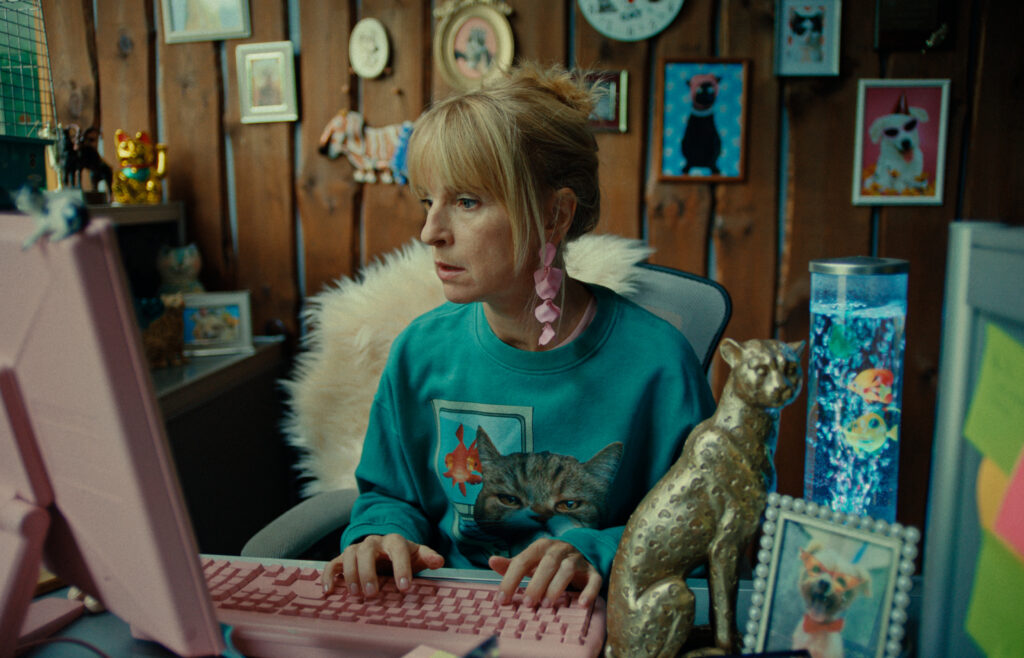
Can you guess my favourite? The lady of the animal shelter! She asks for the zodiac sign of a goat, she has a pink computer, and she knows how to use the delete button!
Juksaar: She is a colourful character. She loves animals, but doesn’t really like humans; making contact with animals is much easier for her.
Did you buy a pink computer?
Juksaar: We painted it. It also had a pink mouse with ears, which, unfortunately, isn’t visible in the frame.
The only person acting relatively normally is a little girl. Is she the only reasonable human being?
Juksaar: I wanted her to be loud, bluntly expressing her feelings, because all the other characters are quiet and stoic. They don’t express their feelings that much.

You mean the others are simply standard Estonians.
Juksaar: Yeah, right. We don’t say a word if it ain’t needed.
Among all these silent people, great importance is given to the sound reel. How did sound contribute to the film’s alienating atmosphere?
Juksaar: Creating the sound design was a hard task, because the film genre is undefined; it’s not classical drama, nor pure comedy… It’s a bit of both. Searching for the right auditory elements, we included many goat sounds. Listening back to the film, I probably noticed a few “baa’s” too many. We experimented with the sound designer for quite a while before we found the right tone for the film.
Would you recommend every family take in a goat?
Juksaar: If you don’t resist a goat to bring change into your life, it might lead you into new and surprising situations, and get you closer to nature. The world could become a better place if we all started giving goats as presents on different occasions, opening ourselves up to life’s changes, and learning to adapt to them. Personally, I’d like to give it a try. Life shouldn’t be taken too seriously, and I’m pretty sure goats would gladly contribute to that.
Gert Hermans