“Smoking is a quintessential part of depicting Dublin”
What makes a film typically Irish? Lots of chatter? Check! Coffee, beer, and cigarettes? Check! Grey streets of an industrial town in decline? Check! And a friendly director and producer saving their festival time to explain the background to their story in great detail? Double check!
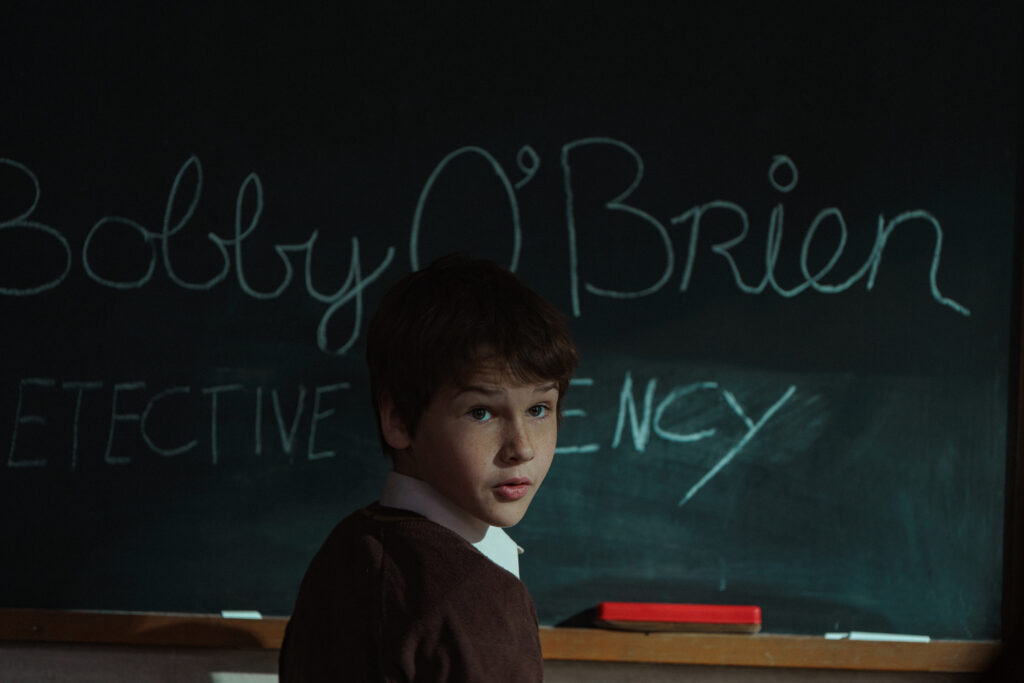
Bobby dreams of becoming a detective, like his TV hero Kojak. When his big brother Oisin goes missing, Bobby and his friend Nell sink their teeth into the case, which sends them descending into a dark, criminal underworld. Their quest refers to incidents from the early 1980s, when parents raised their voices against local drug dealers who were destroying their families. Producer Laura McNicholas sums up the film’s arena: “A child from a working-class background, discovering himself against a backdrop of socioeconomic agitation. Ultimately, SPILT MILK is about a kid understanding the love he has for his family, acknowledging that the world is a bit darker than he expected.”
Bobby is introduced through a brilliant sentence: ‘You always have a plan, and you always get in trouble.’
Director Brian Durnin: Sounds exactly like my life. Bobby’s got a huge imagination and a big heart; he sees the good in things, but he’s missing how much his best friend needs him to be there for her. Throughout the story, he understands that, regardless of all his plans, he needs to start becoming aware of the people who are being good to him.
What’s the importance of brothers? Are you the younger brother?
Durnin: I’m the older one and felt a certain responsibility to guide my siblings in life, whether or not they sensed that. As an older brother, you’re seeing the younger ones making their mistakes. My sister was wild; she got in more trouble than I did. In SPILT MILK, Bobby looks up to his brother Oisin, but he doesn’t want to be like him. He’s very much his own person.

He doesn’t want to be Oisin. He wants to be Kojak!
Durnin: ‘Kojak’ was big in the 70s, and it was all the time rerun in the 80s; ‘Kojak’ was always on TV. Even into the 90s, in Ireland, we had our national broadcaster, and maybe one or two English channels. Daytime TV featured many detective shows: ‘Murder, She Wrote’, ‘Ironside’, ‘Kojak’… Bobby genuinely admires that tough guy, who takes no crap. If there was going to be Kojak in the film, I wanted a scene that had a purpose, a thematic foreshadowing. I watched every episode of Kojak – there are over 100 episodes – and ended up finding a clip with a cool quote and a little wink.
I suppose this cost you some money?
McNicholas: The more people were in the clip, the more we had to pay. So we picked a scene with just Kojak in it. But the football archive scenes were even harder to get. The price charged by the English FA for archive material was astronomical, and eighties football was not archived in Ireland. Luckily, our Scottish co-producers could acquire some material. Our editor, Colin Monie, is an amazing mega-brain. He always knew exactly where we were in the timeline of the movie and was obsessed with details. He only wanted to use games that were really played during that short period. I was like: ‘Who cares?’ But for him, it became massively important.
Another substantial part of your budget must have gone to cigarettes!
Durnin: In the 80s in Ireland, literally everybody smoked. The adult actors couldn’t smoke in the room with the kids, even though the cigarettes were fake. It was a lot of work, figuring out who could smoke and when. But that’s a quintessential part of depicting Dublin in 1984.

Which you have done very meticulously!
Durnin: A lot of the look is in the colour tones. I had some key references, like British photographer Tish Murtha’s social realist reportages about Northern England, and my own family photo albums. Everyone was wearing different shades of brown in those days; the world looked almost sepia. Several people told me: You transported me back to my own family in the 80s.
For that, you needed to find the right location.
McNicholas: Dolphin House is Dublin’s largest remaining public housing flat complex, built in 1957. Many people have moved out, and many properties are empty. We took over a few units. In terms of production design, the O’Brien family flat was pretty much designed like a time capsule, straight to the ’80s.
Durnin: Those social protests actually did take place there, in Dolphin House.
Were those protest scenes based on historical facts?
Durnin: The same thing happened in several flat blocks. All of those communities were feeling abandoned; they weren’t getting enough support from the police or the state. People were dying there; they needed to make a statement.
You must have incorporated many childhood memories, not only in the narrative, but into the details. I suppose you once built towers out of beer mats.

Durnin: That’s based on me, spending time in pubs as a kid; my father was an alcoholic until he quit drinking. Until the age of 12, I was a pub kid, playing under the tables as my dad’s social life was centred around pubs and bookies, around drinking and horse racing. These things were acceptable back then. People used to drive to places, drink, and then drive home, in a car full of smoke, with six kids with no seatbelts on. It was such a different world.
I bet you were doing a lot of jumping jacks in gym class.
Durnin: We had a gym teacher called Ollie. He was full of energy: ‘Here we go, high knees! High knees!’ A muscular man in his fifties, like Popeye. He could balance one of those Swedish benches on his chin and walk around the gymnasium. My school had this big, old gym hall where we climbed the ropes. That’s straight out of my life. I don’t think PE is like that anymore.
Have you enjoyed yourself with clothes and props?
Durnin: Oh, yes! John is wearing one jumper that belonged to my wife’s father, and the other is my father’s. I was just bringing in whatever I could find. There’s a radio from my granny, the little side table in the apartment was the one that my father had beside him, with an ashtray on it; he would sit there and smoke 60 cigarettes per day in a chair that was molded around his body, watching horse racing and Kojak.
Is the rhythm of the dialogues something you had to work on, or was it all there?
McNicholas: That’s all natural; it’s banter. There’s a kind of playfulness in how Dubliners talk to each other, and there’s definitely a musical element to our accent. There’s some bad language in the film, but that’s how people communicate, particularly in the inner city. It’s conversational rather than aggressive.
Durnin: We come from a generally dark, rainy country, so we’re reliant on our personalities to get the energy into life.
SPILT MILK seems to be an ode to motherhood. Behind Bobby’s mother’s weary facade, you can still see a twinkle of light.

Durnin: Dani (Danielle Galligan) is incredible. During COVID, we invited her for an online table read, and she was just brilliant! We were wondering if maybe she was too young, but when somebody nails a part that much, it’d be crazy not to give her the role. She was always intended to be a young mother, but we styled her a little older. Nobody questioned Laurence O’Fuarain as Bobby’s father, although they are both around the same age.
They look totally credible together.
McNicholas: It was important that they felt like a couple. They look a bit worn out because they don’t take good care of themselves, but potentially, they’re a handsome mum and dad.
Durnin: I showed Laurence the reference photos of my father, and he showed me his, and they looked exactly the same, with the same moustache. Laurence usually looks rather buff, like a hunky guy. But he said, All I’m going to do is go to the pub every night and drink pints with my father – which he did. And no gym! I told them both beforehand: I’m not going to do make-up on you. This should authentically feel like the eighties, when people were worn out because they had no money to look after themselves. They hardly knew where the next meal was coming from. They were relying on their wits to keep them going.

Asking you about the title comes from a silly typo that I made, writing in my notes about a film called SPLIT MILK.
Durnin: We didn’t want something too literal; it’s more like a state of mind. Spilt Milk indicates something like, ok, that’s happened, now let’s move on. Bobby is not going back to being a little kid. He puts the hat down; he’s still playing games, but something has matured inside him. He loses some of his innocence, but not his imagination. He just has new information; he knows the world isn’t perfect.
McNicholas: Brian and I, being both parents of young boys, talked a lot about resilience. You want your kids to dream, but you equally want them to have resilience because they’re going to need it. That’s kind of sad, but it’s also a good part of growing up, being able to deal with things when they don’t go your way. Ultimately, this is a film about parents wanting their kids to have the freedom to dream, and unfortunately, lots of kids don’t get that freedom.
SPILT MILK seems like a big labour of love.
Durnin: My connection to the story was obviously personal, based on my kind of upbringing. But I also felt privileged to tell a story about our city, about where we come from.
McNicholas: As Dubliners, we love Dublin. The film captures the essence of what it is to be a Dubliner, even in difficult times. All characteristics that we would associate with Dublin, the sense of humour, the banter, the resilience, I don’t think any of that has changed.
Gert Hermans
Brian Durnin & Laura McNicholas were guests of the Zlin Film Festival
Brian Durin was guest of the Filem’On Festival