“Our audience constantly renews itself”
The rapid rise of streaming platforms is having a huge impact on our sector. Not a single industry event goes by without specialist analysts comparing figures on the consequences for the production, distribution and consumption of (children’s) films. At Filem’On, we were able to get information straight from the source: jury member Emma Tirand represents Benshi, a major French streaming service aimed exclusively at children (and especially their parents). And now Benshi is looking to conquer Belgium with its excellent catalogue of children’s films.
 Can you do an elevator pitch for Benshi?
Emma Tirand: Benshi is a streaming platform for children aged 2 to 11 years old, focusing on interesting arthouse films that challenge their viewpoints. We follow an editorial line with the help of our editorial committee, which decides on every film that is presented on our platform. That editorial line is crucial for what we do.
On the children’s market today, do we need more content or better content?
Tirand: Children are exposed to screens everywhere, all the time. Even parents who closely monitor what their children watch can do little to rectify this. We offer a safe space where children can watch age-appropriate films. We’re the only platform providing such specific age recommendations, which reassures parents. Compared to the never-ending catalogues on channels such as Netflix, Benshi offers relatively few titles. As a small platform, we don’t believe in a constant stream of content; we believe in well-chosen films that spark something in your child, especially since children tend to watch their favourite content over and over again.
You talk from a parent’s point of view. What role do they play in Benshi’s policy?
Tirand: We don’t believe in the cliché that what is made for children is by definition childish. We push for films that are interesting to watch as a family. We believe that creators who work for children need to be extra selective, because this is the time when your audience grows up, discovers things, and develops. Those stories need to be even better than others. Of course, we all know that there are times when parents put their children in front of the television to have a moment to themselves. Both ways of using Benshi are fine. Parents will make choices for their children in line with their own preferences. That’s why we advertise to parents, not to the children. When we talk about Benshi, we talk about the parents.
Why is it important to be so super accurate in your age recommendations?

THE THREE ROBBERS
Tirand: A three-year-old does not have the same interests as a seven-year-old, or a ten-year-old. They don’t have the same knowledge or attention span. For younger audiences, we mainly offer (series of) short films; we rarely show feature films. Classics such as AZUR & ASMAR (Michel Ocelot) or THE THREE ROBBERS (Hayo Freitag) are suitable for those who want to enjoy feature films for the first time. Our age ratings take into account the themes, length, pace of films, etc.
This narrative differs from the usual commercial considerations of streaming platforms, but is entirely consistent with that of most festivals in our sector.
Tirand: Benshi’s roots lie in cinemas, in the Studio des Ursulines, an arthouse cinema in Paris specialising in children’s films. We maintain strong ties with French cinemas and festivals. The importance of discovering films in the cinema does not conflict with our idea that children can also watch them online. These two patterns can coexist perfectly.
How do you keep that bond with the cinemas alive?
Tirand: Benshi consists of two elements: a streaming platform and an online cinema guide. Our editorial manager and her committee watch every title that is released in French cinemas. If a film gets a Benshi recommendation label, we’ll promote it on our website, we’ll post a review, we’ll have announcements in our newsletter, and we’ll look for partnerships with distributors. Since COVID, SVOD has grown tremendously, and streaming has become a part of people’s lives. But it doesn’t exclude the success of cinemas.
What is your personal role in the organisation chart?
Tirand: I’m in charge of acquisitions; I buy films for the platform. Benshi is an editorialised platform, which means that each month, the editorial manager and I work hand in hand to propose themes, to which I adjust my acquisition activities. For instance, last October, we had an interesting selection around exile, for which I bought films like NO DOGS OR ITALIANS ALLOWED (Alain Ughetto), DOUNIA AND THE PRINCESS OF ALEPPO (Marya Zarif), and several shorts. These themes keep coming back, as our audience constantly renews itself – that’s one of the nice things about working for a platform for children. When you start watching Benshi at the age of three, two years later, your preferences will have completely changed, but other children will have come along to take your place.
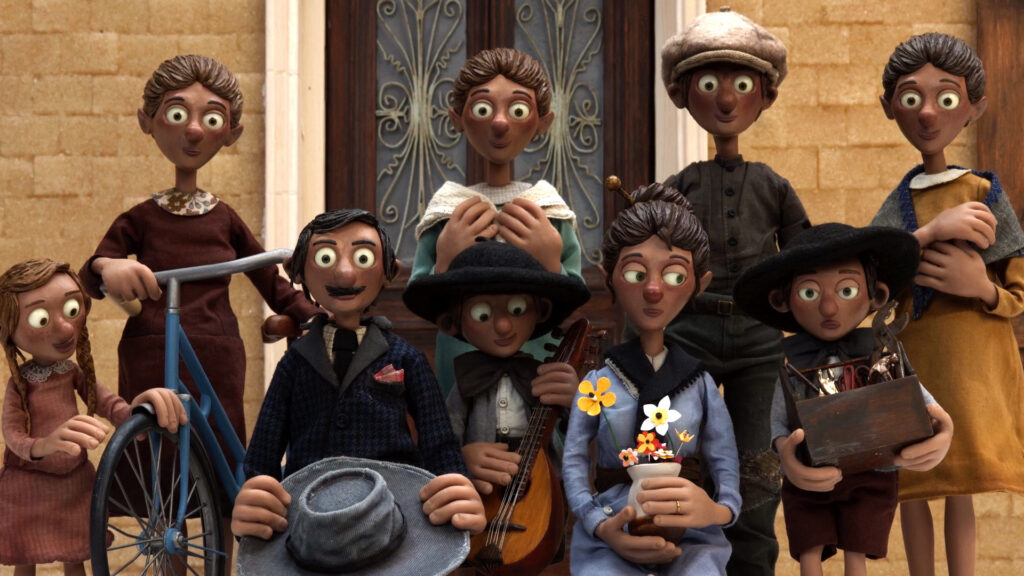
NO DOGS OR ITALIANS ALLOWED
How are things organised on the acquisition side?
Tirand: We mostly buy non-exclusive SVOD rights for French-speaking territories; Benshi has always been a French platform. But in October 2025, we launched a platform in Belgium, the Netherlands, and Luxembourg, with a new website and new films. We partnered with Cinekid in the Netherlands for the launch and with Filem’On in Belgium for a Benshi Award. And from December 2024, we have another platform in the UK. We will further strengthen our presence by offering Dutch and English dubs, and luckily, we offer many films without dialogue.

Emma Tirand
How would you position Benshi compared to other streaming platforms?
Tirand: We’re not the main platform in a family. People come to us for specific, additional content that they’re not necessarily familiar with. They might stay with us for a while, but I don’t see ourselves as competitors with Disney or Netflix. We play in a different category.
Would that audience be comparable to the average festival audience?
Tirand: Not necessarily. What Benshi and festivals have in common is the audience’s trust. Just as schools and families confidently go to a festival, hoping to be pleasantly surprised, parents trustfully come to us to discover something new. The intensity of this experience depends on how much parents are willing to invest in it. If you navigate our age ratings carefully, you can easily find films that you can watch with children of different ages, as a family experience.
Has Benshi already become a brand among producers? As in, “I’ve made a typical Benshi film”?
Tirand: I know exactly what a Benshi film is. I’m not sure if producers want to brand their work as such, but they do know what we’re looking for. Unfortunately, we don’t financially involve ourselves in a project until it’s finished. We don’t do pre-sales… yet..
Do you have an idea about your audience profile?
Tirand: It’s very urban; mostly middle to upper-class families who take their children to cinemas anyway. We reach out to new potential audiences, including those who lack easy access to movie theaters, through social media and parent influencers that are aligned with us, but it’s not easy.
What percentage of your content is produced in France?

THE LITTLE MOLE
Tirand: 80%, I would say. That’s a lot. We also have content from Spain, Italy, Belgium, the Netherlands, and a lot from Eastern Europe, where the stop-motion tradition is strong. Which speaks from patrimonial content, like THE LITTLE MOLE (Zdeněk Miler), that we are happy to include in our catalogue.
Your website shows a list of Benshi’s “heroes”! Who’s on your list?
Tirand: The little bear POMPON (Matthieu Gaillard), the cute bird DIMITRI (Agnès Lecreux & Fabien Drouet), and my all-time favourite short on Benshi is ANATOLE’S LITTLE SAUCEPAN, a lovely stop-motion animation by Eric Montchaud.

ANATOLE’S LITTLE SAUCEPAN
Benshi even has a section for documentaries. If kids have the preconception that documentaries are boring, inaccessible films for adults, Benshi is there to prove the opposite with a very accessible catalogue.
Tirand: Good documentaries for young audiences are hard to find. There are lots of nature documentaries made for television, but we prioritise the cinematic aspect and link it to fascinating themes. Like in THE ANCIENT WOODS (Mindaugas Survila), a Lithuanian film without dialogue, it’s a fantastic experience to be immersed in a forest like that. It’s these kinds of unique adventures that Benshi promotes, because they foster a love for cinema at a young age.
Among all the other streaming platforms, you make a nice, civilised impression: No advertisements, but affordable prices…
Tirand: We are no sharks! In this highly competitive market, we have around 25,000 subscribers in France, and we continue to grow, partly with the support of CNC (French National Film Centre) as well as Creative Europe MEDIA for our European expansion. It is not easy to carve out a place for ourselves in the market, but we seize every opportunity to tap into new markets, and we remain true to who we are.

THE ANCIENT WOODS
Is being a jury member at a festival a suitable way for you to prospect for new content?
Tirand: Filem’On was my first time as a member of an ECFA Jury. It was great to discuss with other jury members, and I’m happy with the choice we ultimately made for GOAT GIRL by Ana Asensio.
Gert Hermans