“Motherboards and wires were always a part of my life”
Love and being in love are physical sensations, but are they so physical that they change the shape and essence of your body? They are, in the world as depicted by Hungarian director Mirjana Balogh in her short film. It doesn’t get much more explicit than in WISH YOU WERE EAR.

In a world where ex-partners have to swap a chosen body part after a break-up, every relationship that ends leaves a visible mark: individuals not only lose a piece of themselves; they also carry a physical fragment of their past love along with them. Even in a harsh digital world, a break-up still hurts as much as ever. After winning the Crystal Bear Award for the Best Short at the Berlinale, Mirjana Balogh’s reflection on how relationships shape our identity and self-image also won the National Lottery Award at the Filem’on Festival.
Did you make a science fiction movie?
Mirjana Balogh: I guess so. I love science fiction; I dreamed of doing something in that genre, involving machines that aren’t possible in our reality.
After the opening scene, I was surprised that the man turned out to be the main character. I was sure you were going to tell the girl’s story.
Balogh: You identify him as male? I intended to present them as a non-binary person. In the world they live in, it’s hard to tell any gender apart.
Come on, he looks ultra male. His tight suit sparks your fascination for his muscular structure, and he has a beard!
Balogh: That’s not a beard; that’s a chin! I wanted the character’s face and hair to be somewhere between male and female. In my mind, it was initially a man’s body, but by swapping all these body parts, he became more feminine, more fluent. But the protagonist is ashamed of his body and covers it up in clothes the whole time.
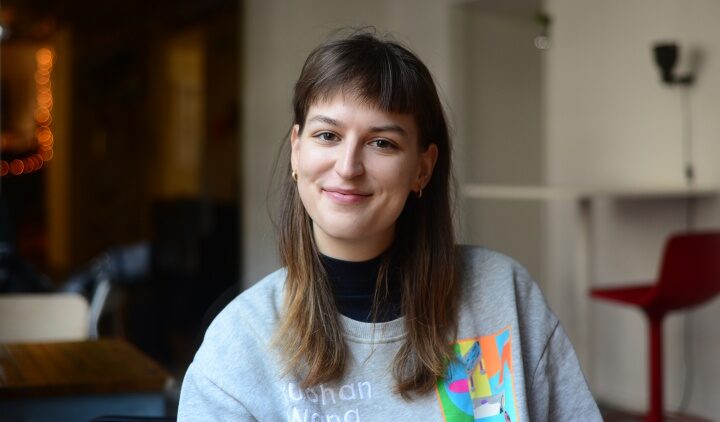
Mirjana Balogh
Perhaps I thought he was a man because he never smiles.
Balogh: Actually, there are a few hidden smiles that you might not have noticed. But in general, the character refuses to smile. Their way of life is rather depressing; there’s not a lot to smile about.
Are you reducing humans to one single body part?
Balogh: Not at all. What I’m trying to make clear is that you carry all your relationships with you, literally, and those body parts symbolise how they shaped you as an individual. Every relationship changes us in some way. I wanted to capture how we can – or cannot – accept these changes. Some people see this transformation as a loss, while others feel that it has become an integral part of who they are. I’ve always been intrigued by how this happens. Even if I spend a week in someone’s company, I notice certain things that I copy in my speech or in my gestures. Isn’t that fascinating? And that goes even more when you’ve been in a relationship with someone. When couples break up, a lot of the other person remains within you. The exact extent of those changes has always fascinated me.
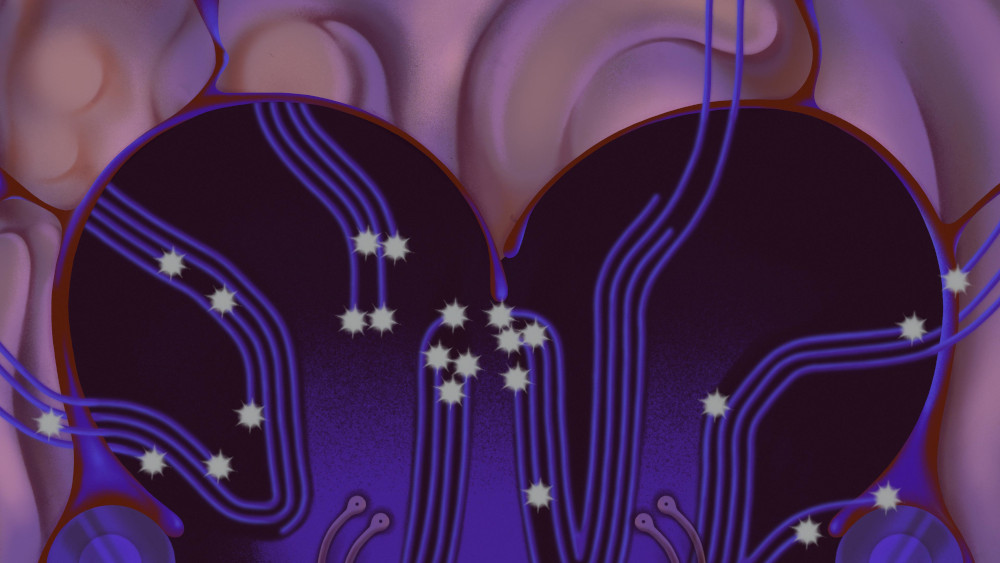
The bodies in your film are very concrete. But you show the heart both anatomically, as an organ that is cut in two, and symbolically. There are a lot of hearts in the film, and often they are more than just a physical thing.
Balogh: In the arena of relationships and breakups, the heart is the most obvious symbol; I don’t know which other shape could have been more appropriate. It also recurs in certain objects: a telephone, a robot, etc. This makes them more specific and meaningful in this phase of the characters’ lives.
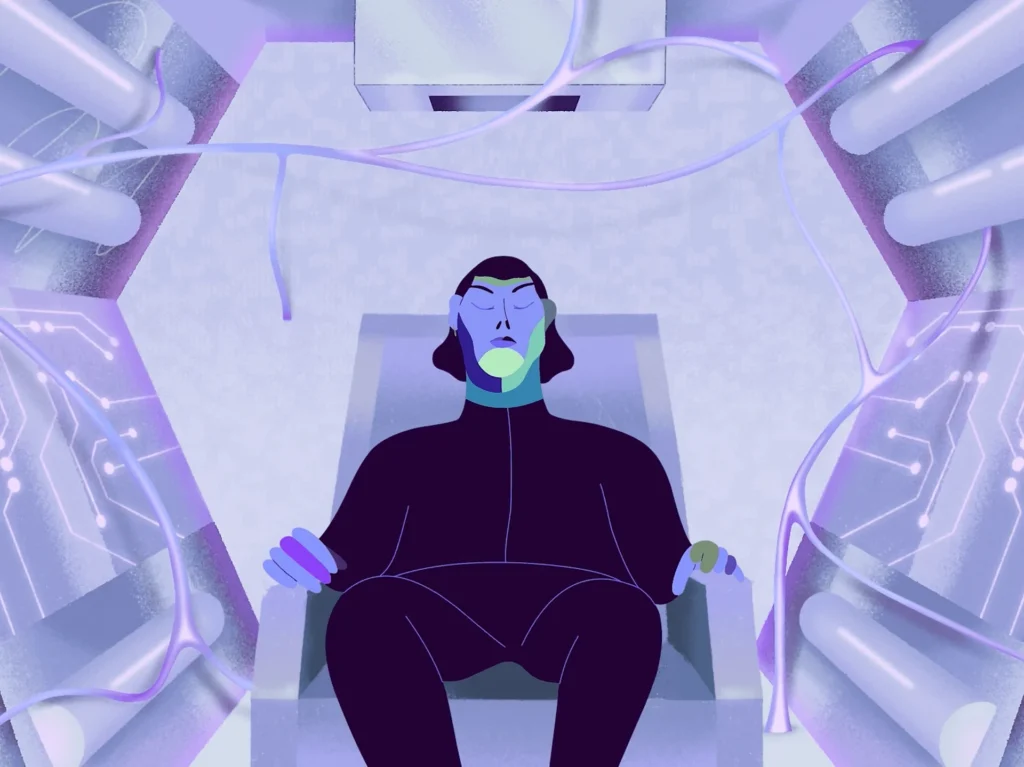
Characters are often watching their own reflection. What do these people see when they look in the mirror?
Balogh: The main character, watching his reflection on the floor, was the first image I had in mind when I started this project. This picture tells the entire story and reminds me of Narcissus, who was always staring at his reflection, because that was what he loved most. When my protagonists look in the mirror, they don’t see their current selves; they see themselves the way they used to be, their original version for which they’re still longing.
Your focus is on the characters, but there are a few locations I’d like to know more about. What about the design of the city?
Balogh: It looks a bit futuristic, but not too much. It’s not a total sci-fi environment. Everywhere I go, I’m taking photos. For this film, I went through my collection and chose the ones I found most appropriate.
There’s an interesting place for recreation. What is it? A hobby club for ceramists?
Balogh: Exactly. I wanted to create a place where people could physically engage in handicrafts, contrasting with the perfect, streamlined body sculptures in the museum. If you are looking for relaxation in this over-organised society, it has to be organised in some way. A hobby club, in other words. In this case, for potters.
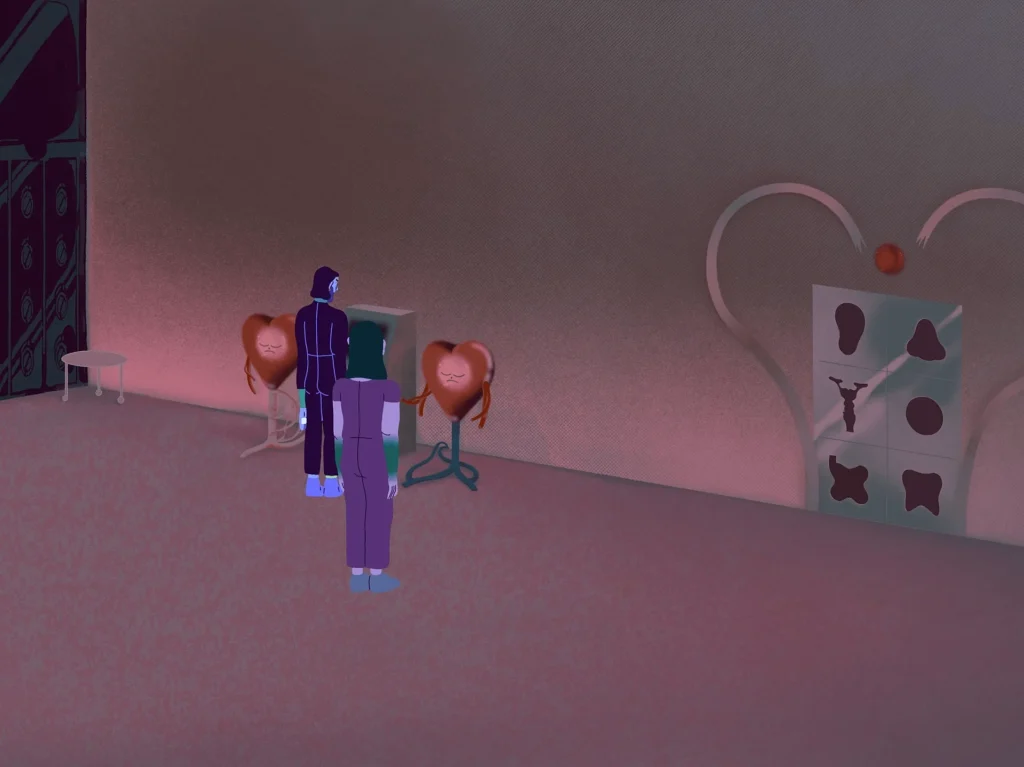
Some of the artworks in the museum are clearly recognisable.
Balogh: I wanted it to feel like a familiar place. That’s why there’s a painting by Matisse, for example. The entire world had to feel recognisable, but not completely; this margin of alienation makes it differ a bit from what we’re used to.
And there’s a discotheque, or at least a place where they dance… in a sensual, futuristic way. What happens there is more than just dancing
Balogh: In an earlier version, they went on a classic dinner date, which didn’t work at all. My editor, Judit Czakó, urged me to take a different approach. Dancing was an obvious solution, showing them moving closer and meeting each other. Technically, I found this part particularly challenging. I’m a terrible dancer myself, so I watched lots of dance videos, and I owe a lot to my superb animator, Luca Tóth, who completed the entire scene. She was the first person who came to my mind when I considered the dance, and she’s the one who finally did it.
You have an interesting fascination for technical processes, computer programmes, calculators, and transplantation machines. What does that tell us about you?
Balogh: My grandfather was an electrician, my father teaches physics, and I grew up with a collection of computers in the attic. Motherboards and wires were always a part of my life, and they stayed with me. Up till today, when I see an intriguing machine or some cool device, I take a photo. I’m not particularly good with machines, I just like the way they look.

There needed to be a pet. Can I call it a dog?
Balogh: It is a dog. I felt like the protagonist needed something to make him more human. He never smiles, he can’t enjoy music, so the least I could offer him was a pet. This dog has also gone through multiple breakups. In my first script, there were many scenes of the dog looking at a female dog. I loved those scenes, but I was told they were too funny, so I deleted them. What I kept were the dog’s legs in different colours; maybe then people will understand what happened. Sometimes I hear a bit of chuckling in the audience. The dog brings some relief; the film needed a dog so that it wouldn’t be too depressing.
If there is any humor to be found in the film, it’s in the first place in the title.
Balogh: Finding a title was one of my biggest challenges. I’m not very good with words, and all the super serious titles I could come up with didn’t fit the film. I adore puns, and I simply couldn’t find one, sitting at home, brooding. Until I googled ‘Ear puns’, and ended up with a hundred possible perfect titles. My father loves Pink Floyd – of course, he is a science teacher – and he was disappointed when I confessed that I hadn’t named the film after the Pink Floyd song.
You did some Q&As. Were there questions that surprised you?
Balogh: Many! The most confronting moment was at the Sarajevo Film Festival. One guy was saying how much it felt as if the movie was about him. Then he turned his head, showing me one extremely big ear. It was huge! I didn’t know what to say.
You’re a product of the Moholy-Nagy University of Art and Design in Budapest, more precisely of the so-called MOME-Anim programme. Does WISH YOU WERE EAR fit the MOME-Anim tradition?
Balogh: I strongly disagree with people saying that every MOME-Anim film is the same. For me, they’re all different and unique, and I hope that my film fits in there somewhere. The film was produced by MOME with the involvement of numerous current and former students, and is promoted by MOME’s Film Knowledge Hub. You can really call this a MOME-Anim film. I love MOME-Anim!
2025 was the year of Hungarian animation! And MOME-Anim is probably one of the reasons for this revival.
Balogh: I think so. Most people working in Hungarian animation were MOME students at some point. It’s a very important place! The people teaching there are also animation artists. They themselves come from MOME-Anim, and then they go back there, creating a beautiful circle.
Your biggest personal success came at the Berlinale, where you won the Crystal Bear in the Generation+ section. What happened there?
Balogh: It was so unreal. I still can’t believe it; it’s just the craziest thing that ever happened to me, and it was hard to comprehend what was going on. I had my hotel breakfast while Michel Gondry was sitting at the table next to me. It went on for a whole week, and I had no idea what I was doing there.
Gert Hermans