“Being with sisters was the essence of growing up”
Claustrophobia in the open air, is that a contradiction? Not in the short film PEOPLE UNDER WATER, by German director Paul Galli, who was a guest at the Filem’On Festival.
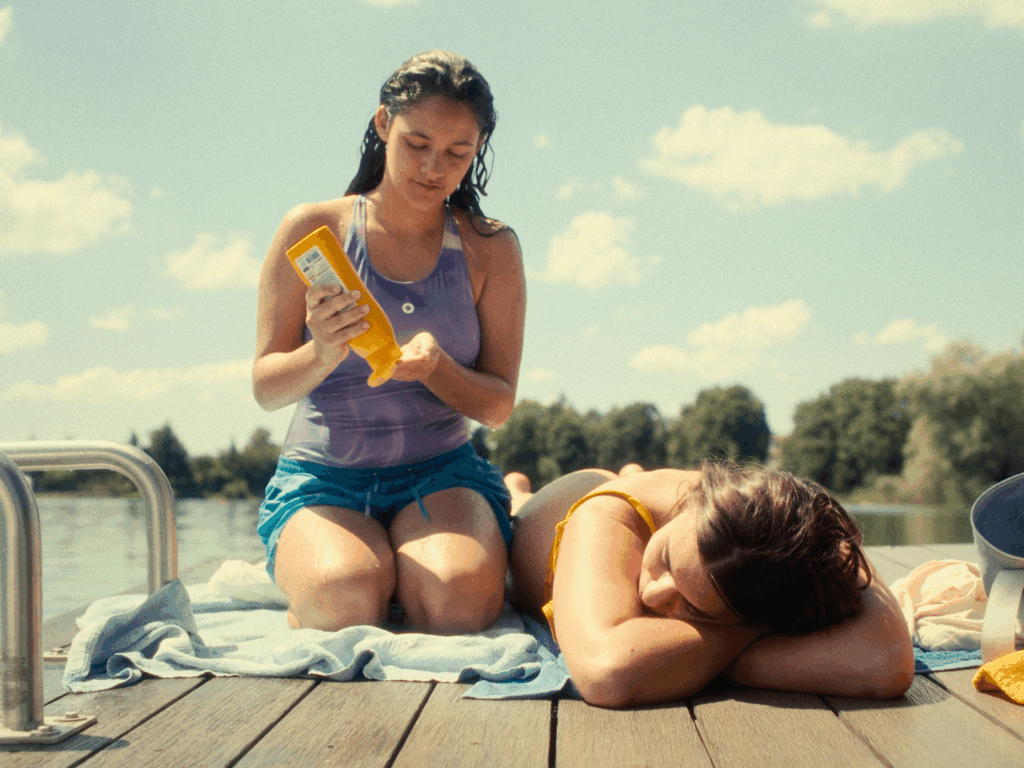
Two sisters get stuck on a wooden platform in a lake with a confident classmate. The location leaves them no room to escape. Long-suppressed conversations must finally be had, making them realise how far apart they have grown. It all starts with a time capsule that the youngest sister, Lila, has put together for a school assignment.
What would be in your time capsule?
Paul Galli: Those time capsules are not really a thing in German schools; I’ve only seen them in the movies. I would put in a gift from my sister. She had this little golden figurine of a pig. As a child, she never let me have it. When I went to South Korea for one year as an au pair, she gave it to me when I left. That was so generous!
What’s so special about sisters?
Galli: I have two sisters; we’re a triplet. Being with sisters, for me, was the essence of growing up. We argued a lot as children, and we still have our quarrels now and then, but looking back on our relationship and how it has evolved, it’s so special to have had their presence throughout my entire life. My film is dedicated to them.
As the one brother in this three-person constellation, did you feel like the outsider?
Galli: I never did. It was never about sisters intentionally plotting against their brother. In fact, the sisterly bond in the film grew out of the relationship between actresses Joana and Sophia Taskiran. I worked with Joana before, and when she told me she had a younger sister who was also interested in acting, we wrote the script for them together.

With so many themes tackled, like sisterly love, depression, gender issues… what would be for you the overarching theme that is keeping all elements together?
Galli: The importance of talking to each other and not burying issues deep inside yourself.
Is that why the film is called PEOPLE UNDER WATER, while all meaningful conversations take place above water?
Galli: They never discuss what truly matters; everything stays bottled up and closed off until it all surfaces during the course of the film.
Which explains the intense silences in your film. I recognised different types: the silence of a lazy summer’s day, silence caused by alienation, by feeling embarrassed, or afraid, or angry. And a silence because you ran out of words to say to each other.
Galli: Together with the scriptwriter, we combined all those types of silence. In the editing, we wanted to let the silence tell its own story, but perhaps I went a bit too far, especially for young people, who might not have the longest attention span. Honestly, I’m not sure if I made the film for young audiences in the first place.

Your story concentrates a lot of intensity in a very small space. How was it, being crammed onto that small platform?
Galli: What we in Germany would call a Kammerspiel, a chamber play. The platform wasn’t probably any bigger than three meters by three, surrounded by the vast water. When they were not in the shot, cast and crew were often swimming. We had paddle boards to go ashore, and two small, unstable boats for the crew to work from. They were connected to the platform, and we had to move them around to keep them out of the picture. Working with a small crew makes things more condensed; after every shot, we took no more than five minutes to prepare the next one. It helped that I had already worked with Joana Taskiran; she knew I was to be trusted, and the sisters were comfortable with one another.
That was no unnecessary luxury. On the platform were three girls, wearing little more than bathing suits.
Galli: We talked a lot with the actresses about comfort and safety, especially with Sophia. Having her sister with her was a great help. A big part of the team was women; a camerawoman might see and capture those scenes differently from a cameraman.
In such a confined space, every movement becomes meaningful. Because you have so little room to manoeuvre, the few elements you do have take on great importance.
Galli: I give a lot of importance to preparation. I want most technical and cinematographic decisions to be made in advance so I can focus solely on the actors. With my core team – I like working with the same people – we lock the entire script before shooting begins, so that there are no more ambiguities. Every step is carefully planned and rehearsed in advance, not to restrict the actresses, but to create a stable framework they can rely on. This preparation allows them to let go on set, knowing the structure works, and to respond freely and intuitively in the moment.

Why this strong need to keep control?
Galli: Our tight schedule was very much dependent on the weather. Actually, the film was supposed to be shot the previous summer. Then it started raining, and it never stopped, so we shot a completely different movie indoors. We met again this summer, with a year’s delay, and shot PEOPLE UNDER WATER. I’m happy we could finally make it!
The lighting is fantastic. You can feel the languor of a summer’s day, with lazy people lying underneath the sun.
Galli: We only used natural light. That was partly a financial choice, but the sun also brings a different quality of light, which was perfect for the movie’s atmosphere. After last year’s experience, the weather made me extremely wary. We only had five days, and at the slightest disruption, we would have to call off the plan again. Every cloud in the sky made my tension rise.
Gert Hermans