“You need to feed the forest”
In the short Norwegian documentary WITH GRACE, the 13-year-old title character, a witty girl with big dreams and an exceptional talent for making everyone laugh, introduces us to her loving farming family in Kenya. Spurred on by the devastating impact that nature has on their lives, Grace’s father experiments with a simple method to make their environment more livable. At the Filem’On festival, producer Arne Dahr came to tell us exactly how it works.
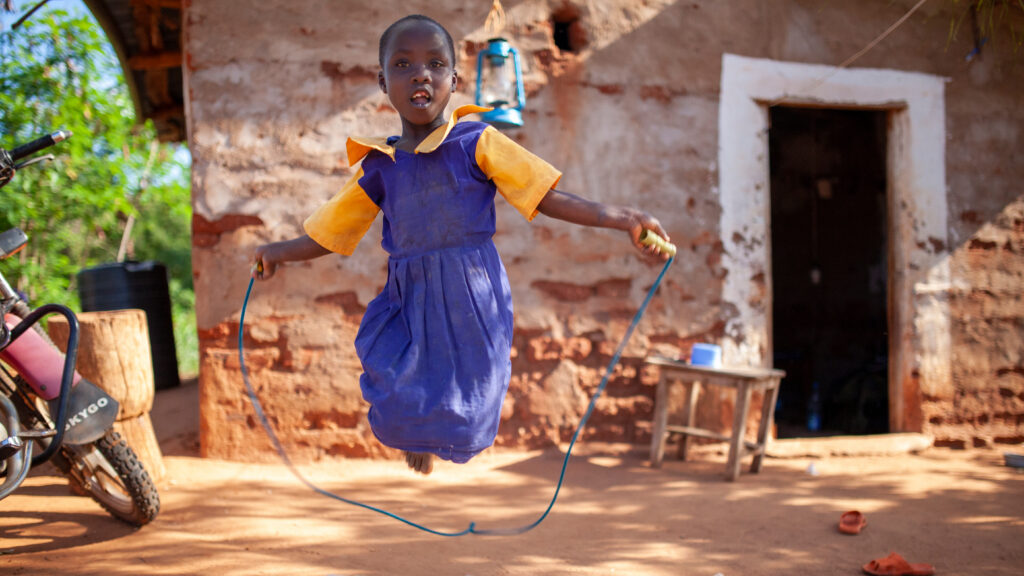
Significantly, the film begins with the image of a tree.
Arne Dahr: Trees are so important for this film. This family is planting trees to let them grow into forests, which provide shade and humidity, even in the desert. You need to feed the forest until it is big enough to continue growing on its own. That is how an oasis will emerge.
In my garden, the plants all die, but in the desert, they can survive!
Dahr: The main idea of Kisilu, Grace’s father, is to build a farm where people, animals, and plants can grow into a new ecosystem. Desert ground can be cultivated, certainly in Kenya, where the soil is very fertile. The main problem is the lack of water. But if you plant seeds and water them for a while, the ecosystem evolves. Kisilu has gained the trust of his neighbours, who start following his example.
Those people’s lives depend on whether there is water or not.
Dahr: So do our lives, but we don’t feel it yet. This film is about climate change, affecting the lives of people living in the midst of nature, with nature, and cultivating nature. If the rain doesn’t come, their entire life will change. They don’t have the buffer zones that we have.
Grace’s father is the one promoting this new way to survive nature’s harsh reality.
Dahr: He is a visionary! Kisilu is a remarkable man who manages to gather his neighbours around him, form a community, and convince them of his mission. He manages to lead them positively, and people like his ideas and want to try them out together.

He is also the one who breaks the circle. All the other fathers leave for the city to make money, but he wants to stay with his family.
Dahr: Grace has eight siblings, and you see Kisilu around his kids all the time. Whether there is a flood or a drought, or even if the house collapses, there’s always a smile, and there’s always friendliness. You never see him lose his temper. He is very different from the clichés about strict or absent fathers. The question if he will have to move to the city greatly concerns Grace.
What would make him leave his family?
Dahr: The necessity to make money to feed his family and pay for schooling, which is very expensive in Kenya. There are no public schools that offer free education, but he insists that his children, both sons and daughters, receive an education. Kisilu didn’t leave; he is still with his family, and they manage to live off the farm. And there’s one more hero in this film. Despite her worries, Kisilu’s wife, Christina, is never stressed. She supports her husband and runs the family. In addition to climate change, this is also a film about hope and about good parenting.
We see Grace looking at pictures of herself as a baby. Who took those pictures? How come you followed that family for so long?
Dahr: In 2017, director Julia Dahr made a film about Kisilu called THANK YOU FOR THE RAIN. That’s when she met little Grace and decided to come back later to make a film about her; we’re observing her father through her eyes. Julia is extremely devoted to this theme. She became friends with the family, and over the years, she returned many times. She has lived with them, and Kisilu came to Norway to visit her. The images you see of Grace as a little girl are footage that was shot over the years on all those trips.

You decided to use a voiceover.
Dahr: We had many discussions about that. It’s Grace’s voice that you hear, both in English and in her own language, and there’s a third version available in Norwegian.
You can hear her laughter after every sentence she says.
Dahr: That’s typical for Grace – it was real, and that’s why we didn’t cut it. Voicing the film was a complicated process. Grace had to travel to the capital, Nairobi, which is a two-day trip for her. She made it with Dina Mwende, our Kenyan co-director. But Grace is attending a boarding school, and they didn’t want to give her time off. We needed to talk to the principal, and many other people were involved. But we insisted on having her voice, and despite the complicated process, it worked out very well.
Grace recalls many fond memories. And there’s one particularly beautiful story about a yellow dress.
Dahr: I’m happy that you like the story. We had the BBC involved in the production; they were very much into all these details, and the yellow dress was one of them. They insisted that we see that dress, but the directors didn’t want it, and we didn’t have the image. So we had to come up with a creative solution. It’s a strong little story within the bigger film.
She recounts how the dress made her feel like a princess, until a storm blew it away.
Dahr: “And I never saw my yellow dress again.” Her mother lost all her underwear in that storm, and that makes everybody laugh, even though the house has collapsed.

What else should we pick up from life in that village?
Dahr: People live outside all the time. There isn’t even a door to mark where “inside” begins. You only go inside to sleep or have some shade. They eat together, but not like us, having three meals a day. The family eats when there is food; even if mum starts cooking in the middle of the night, everybody wakes up to eat. For Grace, this is a lovely memory. Audiences need to see how people are living and having a good time like that.
Is that a message you want to convey to your audience?
Dahr: The film is being shown on several TV channels, including the BBC, and has been screened at at least 90 festivals. Julia would like to go back once more and make a third film about Christina, to show life in Kenya from a woman’s perspective.
Is it correct that this film is a ‘project of love’ from an uncle for his niece?
Dahr: Julia is my niece, and I’m her godfather. When several employees in Julia’s company, Differ Media, became pregnant at the same time, I stepped in to finish two projects in production. I stayed for almost two years.
Gert Hermans