“Thousands of trees stand between them”
As a Brussels festival, it is quite special to present AUTOKAR, an animated chronicle about Polish labour migration to Brussels in the 1990s. A little girl boards a Polish bus with Belgium as its final destination. The bus seems so big, the child is so small, and the journey is so long. When she loses her precious pencil, her search through the bus brings her face to face with her remarkable fellow passengers. In this way, the director gives shape to a childhood memory, with Brussels as its final destination. After the film’s successful premiere at the Berlinale, Sylwia Szkiladz came to explain the story at a festival in the city that has since become her home.

Times have changed; what happens in your film is completely unthinkable nowadays: a child has to travel thousands of kilometres on her own, on a bus from Poland to Brussels. But it is your story, and that of many children like you.
Sylwia Szkiladz: I arrived in Belgium in the 90s, when Poland was not yet a member of the European Union. People came here without a plan, without papers, not knowing what kind of work they might find, which was both exciting and frightening at the same time. Part of my family lived in Poland, another part lived in Belgium; as a child, I constantly travelled back and forth. Such independence was not unusual among Polish children of my age. With my Polish classmates in Brussels, we didn’t even talk about it; it felt normal to us. Only when I grew older did I realise how unusual that situation was. It’s an experience that I share with many kids of my generation.
If you wanted to take a “piece of home” with you, that happened through the food that you brought.
Szkiladz: My parents came from a rural region near Belarus, where people provided for their own livelihood. Moving to a new country without money or a home, the family wanted to ensure that there would at least be something to eat. I remember the bags and suitcases, bursting with food, and hard to carry; often, the handle broke off. The family sent us all that food not only because they thought we were starving in Belgium, but also so that we would think of them whenever we ate it. Through the food, they tried to be with us.
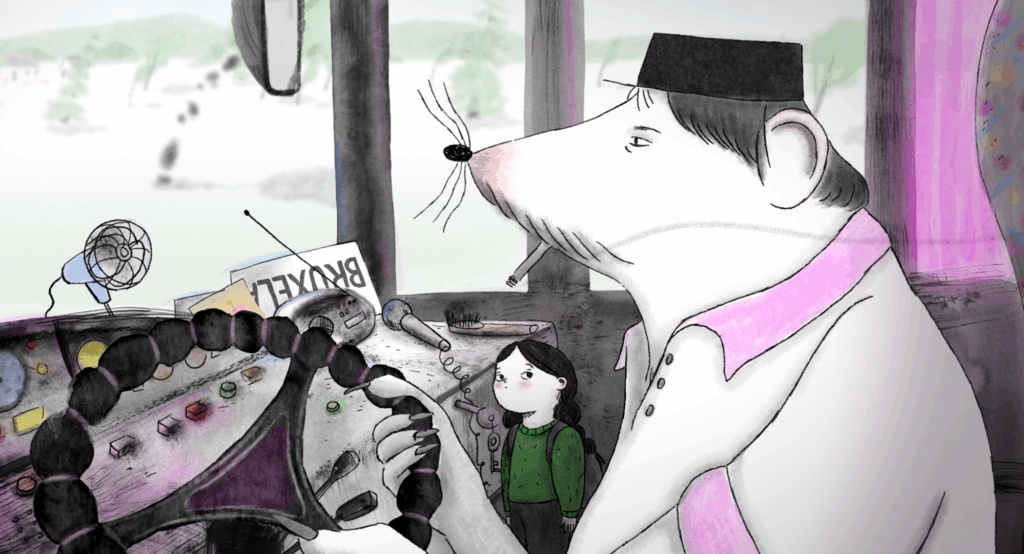
We, Belgians, thought you were coming here because this was the promised land. From the film, I understood this wasn’t the case. The promised land is where the heart is, and the only reason for coming here was money.
Szkiladz: It is hard to understand the exact reasons behind such a bold decision; they were young and completely unaware of what life in the Western world was like. Money was certainly one factor. In Poland, people presumed that all Belgians lived well, and that we, as hard-working people, could aspire to the same. It was also partly out of curiosity. My parents were in their early twenties. For them, it was a way to discover a world they had never known.
There must have been a tremendous sense of nostalgia in this community.
Szkiladz: Nostalgia isn’t always a healthy driving force; at times, it kept me from moving forward. I felt as though I wasn’t fully living in the present. As an adult, I wanted to move on in life, while preserving what mattered from those experiences. That’s one of the things that pushed me to make this film.
What do all the people in the bus have in common?
Szkiladz: Only when seeing the finished film, I realised that all characters had lost something, – a family, a home, a language, a pencil,… – and each of them deals with it in its own way.
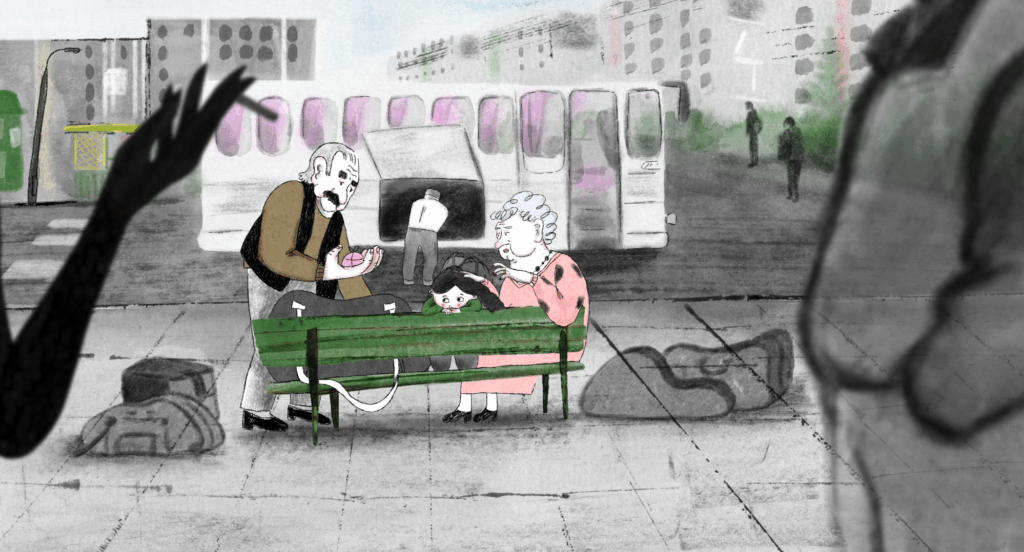
And they are all animals!
Szkiladz: We are watching through the eyes of an eight-year-old girl, coming from a village, surrounded by forest. She has heard all the stories people tell about forest animals and takes them literally. Her head is full of them. When she is afraid or overwhelmed by the trip, she digs into her imagination, and naturally, all those half-human characters appear. In this way, Agata brings something from her world onto the bus. These anthropomorphisms helped me tell a story that is close to my own. I needed some distance; I didn’t want to portray the people I actually encountered during my many crossings. Drawing humans with expressive features can easily become overly caricatural. The anthropomorphic bodies helped me exaggerate the characters freely, using the world of fairy tales. I was able to draw quite naturally from the codes of the coming‐of‐age tales and the fantastical.
My house is following me, she says!
Szkiladz: She left her home behind, but the house is still there, and thousands of trees stand between them. That house in itself is like a story with no ending.
Agata’s face looks minimalistic, no more than a few stripes. How did you make her so expressive when you had so few elements to work with?

Szkiladz: Through the combination of explicit body language and naturalistic voices. Before we started working on the animation, we recorded the voices in Warsaw with Polish actors. We couldn’t predict how Belgian animators would correctly shape an inner world through a language they didn’t understand. Take, for example, the “bear” on the bus. The animator initially portrayed him as far too rude, almost violent. Yet we needed to feel his human warmth, his underlying concern. Throughout the animation process, we prioritised emotion over technical perfection. It made us feel connected to the characters in a raw, imperfect, perhaps more truthful way.
Another interesting character is the she-wolf, who leaves the bus, wanders into the forest, and is later picked up again. What exactly is going on there?
Szkiladz: That’s a typical question from the Western world. In Poland, everyone immediately understands what is happening in that border scene. We can assume she doesn’t have the proper papers, so she crosses the border on foot through the forest and is picked up again on the other side. We also understand that she isn’t a bad person. She introduces Agata to artistic creation, giving her the pencil and drawing with her. She is the only character who doesn’t speak; we can imagine she comes from even farther beyond Poland. What matters is how our perception changes throughout the story, even though she is initially presented as potentially unpleasant.
We also get to see how border controls were organised, with bribery and greedy border patrols.
Szkiladz: People sometimes tell me how the film gave them goose bumps, because it shows exactly how things were. Only a few years later, Poland joined the EU. Everything happened very quickly for us, and there was never enough time to emotionally process all these changes. These stories are rarely talked about; there is still a certain shame in speaking about them. People prefer to forget. It felt good to take the time to work on this sequence, but it was difficult for me to construct. I expected it to be easier.

You created a beautiful visual contrast between the sharply outlined characters and the more vague backgrounds.
Szkiladz: This contrast between bright, fluorescent colours and black and white reflects the way I remember Poland at that time. AUTOKAR was drawn digitally in TVPaint with Cintiq, a programme for hand‑drawn 2D animation. Together with the artist Noémie Marsily, we designed the backgrounds using Chinese ink on paper, sometimes very sharp, sometimes a bit watery, but always with a focus on textures. We scanned and painted them in TVPaint, using the same brush as for the characters, which creates a connection between both layers.
How would you summarise your artistic journey to date?
Szkiladz: I was born in Poland, in Sokolka, near the Belarusian border; this region continues to inspire me. I grew up in Brussels, I arrived here when I was eight, and studied Visual Arts at Saint‑Luc and Animation at La Cambre, where we were encouraged to submit our films to festivals. That was very enlightening: meeting people and observing how the industry works felt like an important part of my formation. In 2015, I did a young artist residency at Studio Folimage, where I made THE TEENY-WEENY FOX with Aline Quertain (also screened at Filem’On). For more than 12 years, I have been running animation workshops under the name “Les Films du Lapin Masqué” with a wide range of participants: children, teenagers, seniors, animation students, in festivals, homework schools, kindergartens, retirement homes, migrant centres, in Poland, Belgium, Morocco, France. This diversity of encounters has inspired me enormously. Those people have taught me how to tell stories quickly and collectively, with few resources. What matters most is the energy. I tried to bring that joy of creation into AUTOKAR, resisting the temptation to be too perfectionist.
At Cinekid, AUTOKAR won the Best International Short Film Award!
Szkiladz: All this was so unexpected! Because the setting of the film is so deeply Polish, I wasn’t sure whether it would work internationally. After the Berlinale, we received a flood of festival invitations, and the film already won several awards. In the meantime, I am working on my next project, but I can’t say much about it yet. The only thing I can reveal is that it will be an animated feature co‑produced by Lithuania, France, and Belgium. The project is still in its early stages, but is off to a very promising start.
Gert Hermans