“When cinema creates something that wasn’t there before”
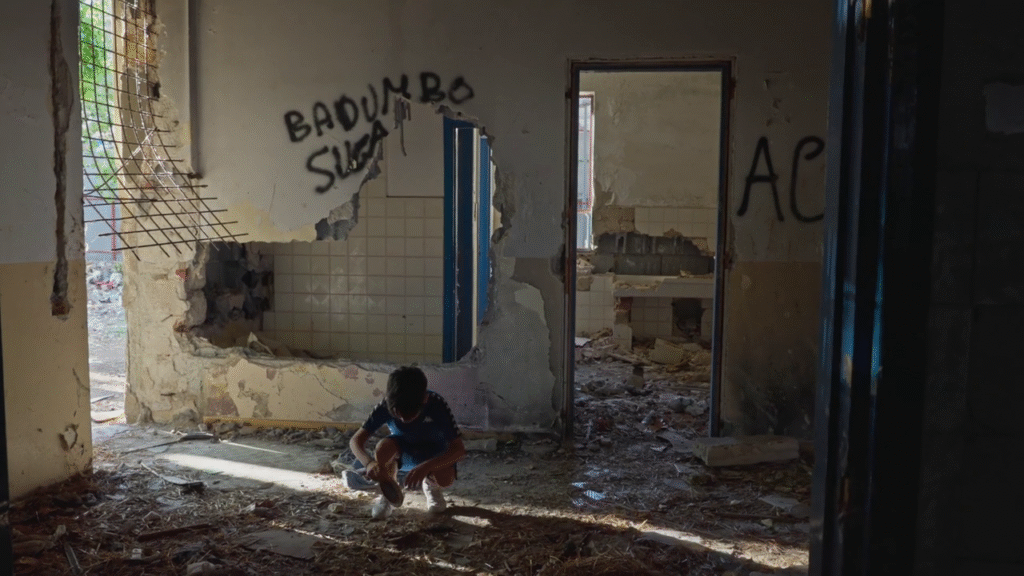
In the middle of Palermo, Sicily, stands an old, abandoned kindergarten. People say the place is haunted and should be avoided. But three children – Angelo, Mary, and Rosy – find a secret hideout there, a safe haven where, out of sight of the world, they share their imagination and fears. Until their refuge threatens to be demolished. Three directors (Virginia Nardelli, Stefano La Rosa & Danny Biancardi) follow in their footsteps – we spoke with two of them at the Filem’On Festival in Brussels.

The documentary was filmed over a long period of time, but feels like a snapshot, a crucial moment in a young life, with a foreshadowing of the life that awaits them, and which they are already reflecting on. With compassionate understanding, the filmmakers observe this moment between hope and sorrow.
For a children’s audience, THE CASTLE might be a film about building up something, while for me, it was more about losing something.
Stefano La Rosa: As an adult, you might see something you already lived through but lost, and now you remember it. That evokes a certain melancholy.
Virginia Nardelli: When the kindergarten was destroyed, it felt like we lost something so beautiful. But it’s also a positive thing: a school will now be reopened. By doing a good thing for the community, a sweet dream for the children was shattered.
Where exactly is this story situated?
Nardelli: In Palermo, in the heart of the city, but the neighbourhood feels suburban, because the community completely ignores it. There are no shops, no bars; no public transport goes there. The only people on the streets are those living there. If you accidentally ended up there, you would be approached on the street: “Sir, I think you’ve taken a wrong turn. Were you looking for somewhere else?”
La Rosa: There is only one road leading there, which winds around the kindergarten and the square. On that road, kids are riding their quad bikes and scooters all day long; that’s how they spend most of their time.
Groups of children hang around. In one scene, they are giving Angelo a rough time. That felt unpleasant, or was it just a harmless game?
Nardelli: That was an observation of how brutal things get on the streets. We felt uncomfortable filming it, so we asked Angelo and his parents whether or not to include that scene in the film. For him, it felt normal.
That explains why he says, “I love this neighbourhood, but not the people.”
Nardelli: If you’re not a full-blooded macho man, then you’re an outcast there.
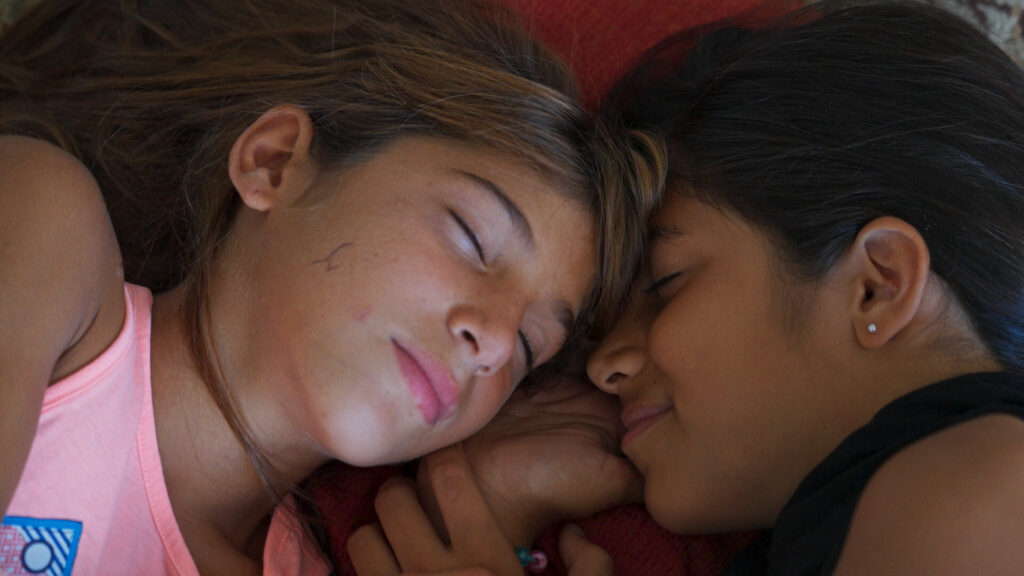
La Rosa: Angelo simply isn’t like that; he has a gentle way of connecting with people, very different from the other kids. When we met him at the age of nine, he was not yet fully aware of that. But over the three years we’ve spent there, everything changed, including his perception of himself and of the neighbourhood. At a certain point, hanging out with two girls became problematic. Gender models are still approached in a traditional way there.
The girls tend to be dominant, while Angelo is more thoughtful.
Nardelli: Mary is rather bossy, Rosy is wild, and Angelo is more reflective. This created an interesting dynamic. But as soon as another kid entered the group, that balance fell apart.
La Rosa: Initially, it didn’t matter much that he hung out with girls; he was still a child. Then, little by little, it became trickier until, at one point, we were afraid to jeopardise his social life in the neighbourhood! But he said, “No, I want to do this!” The obstacles were a mixture of social codes and jealousy. Other kids also wanted to be part of the film project, but as soon as they joined, they messed up everything. We constantly had to take those social dynamics into account.
How much did you guide those children? Why did they do all the things they did?
Nardelli: We were there for 70 days to film, but we spent at least twice as much time there, doing other things. We set up a framework for them to improvise. Sometimes it worked, most of the time it didn’t. We had to wait for all the variables to fall into place, creating the perfect conditions for a cinematic moment. That happened rather organically than scripted.
La Rosa: We wanted to document something beyond their daily lives, and building up this new space with them in the kindergarten was a perfect occasion. They brought us there, and Rosy said, “What a mess; let’s clean it all up.” We thought: perfect!
Doing most of the ‘construction work’, she isn’t afraid of getting her hands dirty!
Nardelli: Rosy is wild. She got herself quite a reputation for being a free spirit. For the film, she felt free to take it all out, without being judged by others.
La Rosa: This was her ultimate chance to prove herself as someone who could act responsibly and take care of things.
Nardilli: Her parents and teachers were surprised. “We’ve never seen her like this. This is a side she never shows.” She was the most attached to the place. While workers had already begun demolishing the building, she kept tidying and cleaning. For me, that was one of the most emotional moments in our project.

Being proud of their work, they have a strong sense of ownership. This was really their place.
La Rosa: In this intense neighbourhood, it’s difficult to find private space, but they created one for themselves. When they wrote their names on the wall, we were like… Yes! That makes it clear what this place really means to them.
Although their conversations sound surprisingly poetic and philosophical, we hear their daily concerns shining through. Did you push them to have such talks?
Nardelli: They can’t be pushed!
La Rosa: The scene in which they talk about their fathers in jail started as a simple game, but then the tone of the conversation changed unexpectedly. Such stories are simply a part of their lives. Each family there has at least one family member in jail.
They also say that growing up scares them.
Nardelli: Growing up means following in their parents’ footsteps. Mary’s parents were only 14 when her mum gave birth to her – in one year, she will be the same age as her parents when they got her. Starting your own family is the only way to escape from the family nest. In that sense, every kid there is afraid to grow up. Mary says: When we will be married, being together like friends won’t be possible anymore.
La Rosa: As a grown-up, boundaries are stricter. You can’t hang around with male friends any longer. THE CASTLE tells about growing up in a context where social codes are strong, and your range of options is narrow; you don’t have many. That’s a sad aspect of their lives. There is a political side to the story. Such neighbourhoods are often talked about in terms of clichés that we tried to deconstruct. We approached these themes without projecting preconceived ideas. We let those kids take us somewhere, in their own way.
The moment I learned the most about Angelo was in the song he sings, about “how nothing will change and we can stay here forever”.
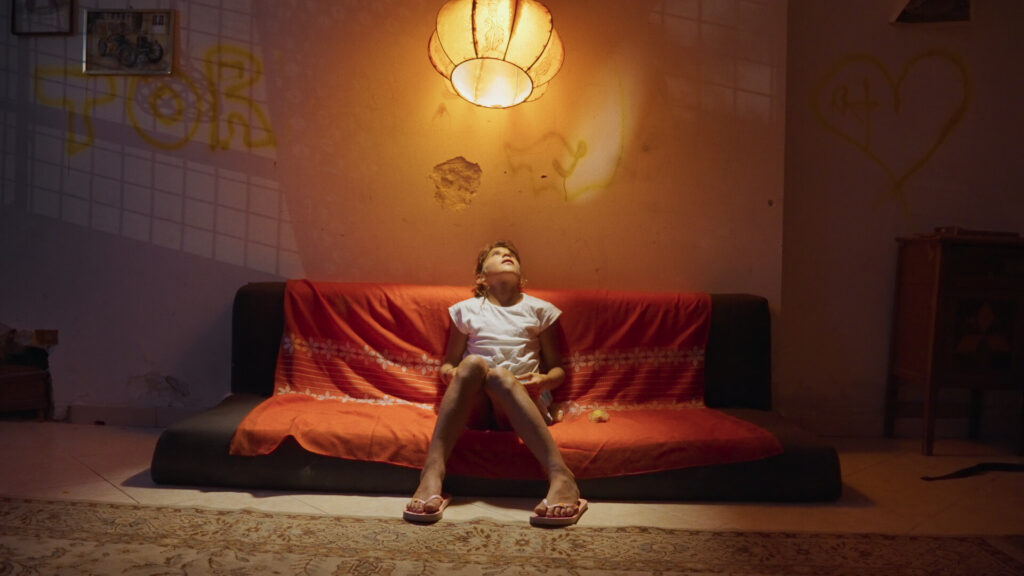 La Rosa: That song is sung in a strong Neapolitan dialect. This ‘Neomelodica Napoletana’ music is very popular in that neighbourhood, but we couldn’t understand the lyrics. We still don’t know exactly what the song is about, but the only words we could get – ‘Nothing will happen’ – did fit perfectly with that moment in the film.
Although you came as outsiders, they seemed to trust you completely.
La Rosa: We have earned that trust over time. Without patience, we would never have achieved this level of intimacy. We have constructed this story together with them over four years. For us, this was a lesson in finding different narratives, simply by letting people talk freely. We only created a framework for them.
Nardelli: We discovered our film while making it.
The demolition of the kindergarten is inevitable. Did you know all along that this was about to happen?
Nardelli: We knew there was a plan, but in Sicily, plans can stay on hold for years. But then suddenly it happened, and we were not ready for it.
La Rosa: We were still about 10% short of the planned recordings, so we had to find creative solutions. But we knew from the beginning that the renovation works could be a nice ending point.
But it’s not the end! Why does the film end the way it ends?
Nardelli: I love it when cinema creates something that wasn’t there before. When the realistic part of our story ends with the destruction of “our castle”, we created another magical space elsewhere, where we can return at any time in our imagination.

Have the kids seen the film?
La Rosa: We showed a preliminary result to the children and their parents to obtain their approval. But the Italian premiere at the Biografilm Festival in Bologna was the first time they had travelled by plane, stayed in a hotel… It was a very complete experience.
Nardelli: That was stressful for us. I remember myself shouting at 4 o’clock: “Girls, please, go to sleep!“ But they had great fun!
We didn’t talk much about cinematography. Maybe because it all felt so natural. Was there a big cinematographic plan behind it?
Nardelli: A lot of scenes took an amazing start, but then faded out, because children easily get bored. In the editing, we synthesised them a bit.
La Rosa: The filming happened rather spontaneously, without thinking about the decoupage. We ended up with loads of footage and four months to edit it.
Gert Hermans